Detuned Reactor vs. Harmonic Filter: Which One Do You Need for Your Facility?

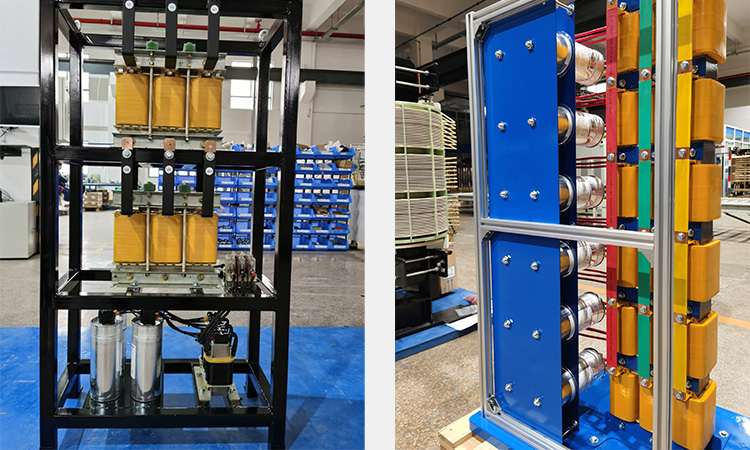
Comparison of a high-linearity detuned reactor and a power factor correction assembly for industrial harmonic mitigation.
Figure 1: High-linearity detuned reactor (left) vs. PFC assembly (right).

To optimize operational efficiency, modern industrial facilities always use Variable Frequency Drives (VFDs), soft starters, LED lighting, and switching power supplies. However, these non-linear loads bring power quality issues due to harmonics.  

To address overheating transformers, nuisance circuit breaker tripping, or blown capacitor fuses, there are two key solutions: detuned reactors and harmonic filters. 

Both of them can help mitigate power quality risks, but for different purposes. This guide details the technical distinctions, installation topologies, and selection criteria of detuned reactors and harmonic filters. So you can make the right choice.
1. Why Are Harmonics and Power Factor Correction (PFC) Interlinked?

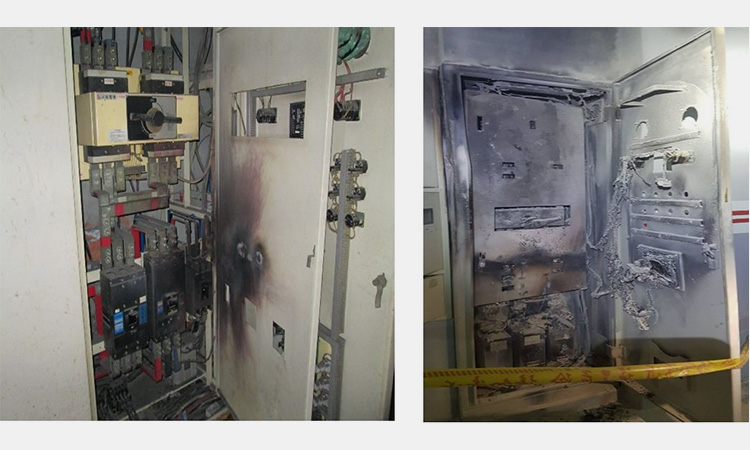
Damaged industrial electrical cabinet and capacitor bank caused by harmonic resonance and overvoltage.
Figure 2: Harmonic resonance can lead to severe capacitor failures and unexpected plant downtime.

Power Factor Correction (PFC) capacitor banks are specifically designed to help with reactive power (kvar), utility penalty fees, and transformer capacity. 

However, if you connect a standard capacitor to a system full of harmonics, the capacitor will interact with the main supply transformer due to the capacitive reactance and inductive reactance. 

So there will be a parallel resonant circuit. When the natural resonant frequency aligns with the harmonic frequency, the harmonic currents and voltages will be exponentially amplified. 

In the end, it will lead to severe overvoltage, bulging or exploding capacitors. Your plant will suffer unexpected downtime and great loss.
2. What Is a Detuned Reactor and How Does It Protect Capacitors?

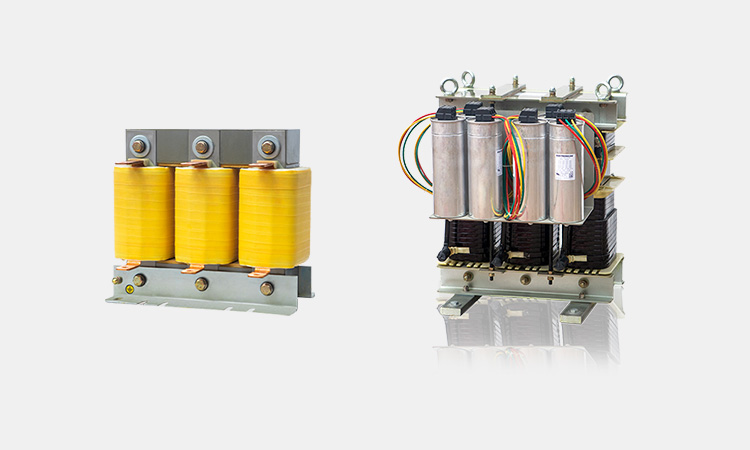
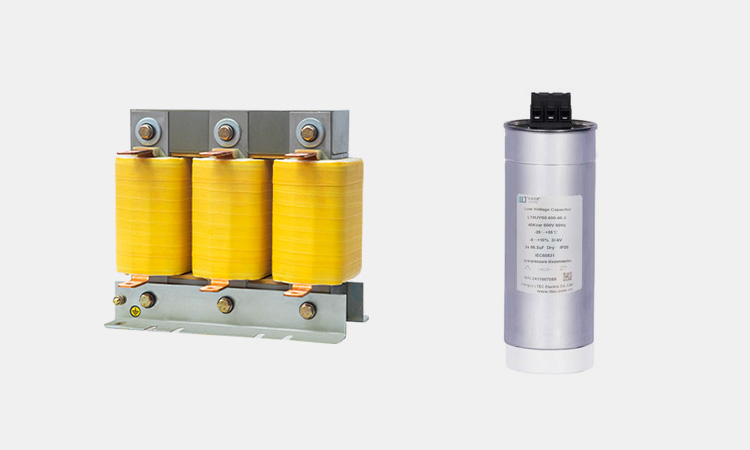
A three-phase iron-core detuned reactor paired with a low-voltage PFC capacitor for industrial harmonic protection.
Figure 3: Three-phase detuned reactor (left) and PFC capacitor (right).

Also called an anti-resonance or blocking reactor, the detuned reactor is a heavy-duty three-phase iron-core inductor. It is connected in series with a PFC capacitor.  

How does it work?

With a precisely calculated inductance ($L$), the detuned reactor can shift your overall system resonant frequency below the lowest-order harmonic. So your capacitors are protected from destructive current overloads. 

3. What Is a Harmonic Filter (Passive vs. Active) and How Does It Clean Power?

The detuned reactor is mainly applied for protecting capacitors. However, the harmonic filter is applied for absorbing or eliminating the harmonic currents directly from the power distribution system.

Passive Harmonic Filters (PHF)
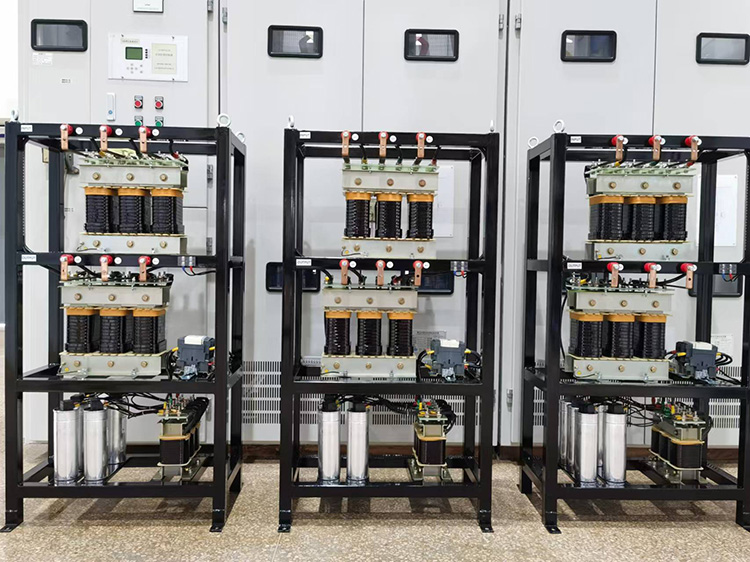
Engineered passive harmonic filter racks featuring LC circuit components for industrial harmonic mitigation.
Figure 4: Passive harmonic filter (PHF) racks with multi-stage LC circuit configuration.

Connected in series or parallel ahead of non-linear loads (like VFDs), the passive harmonic filters are engineered LC or LCL circuits. By creating an ultra-low impedance path at specific harmonic frequencies (e.g., $250\text{ Hz}$ for the 5th or $350\text{ Hz}$ for the 7th), they can divert harmonics away from the upstream utility grid. 

Active Harmonic Filters (AHF)
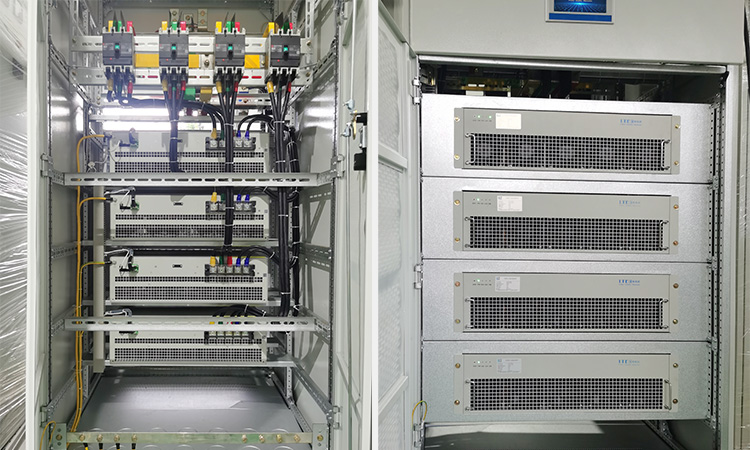
Modular active harmonic filter (AHF) cabinet used for real-time industrial harmonic cancellation.
Figure 5: Modular Active Harmonic Filter (AHF) system.

Connected in parallel with the main busbar, the active harmonic filters can monitor load harmonics in real time with current transformers. By injecting equal cancellation currents $180^\circ$ out-of-phase, they can dynamically neutralize harmonics up to the 50th order.  

4. What Is the Fundamental Conceptual Difference Between the Two?

Detuned Reactors vs. Harmonic Filters: Key Differences


Detuned Reactors

Harmonic Filters

Primary Focus

Capacitor Bank Safeguarding & Anti-Resonance

Grid Cleansing & Standard Compliance

Main Objective

Enable safe PFC without amplifying system harmonics.

Actively or passively trap harmonics to meet grid compliance.

Compliance & Standards

Basic protection; not designed for strict grid emission limits.

Engineered to meet IEEE 519-2022 ($\text{THDi} < 5\%$) or EN 50160 ($\text{THDv} < 8\%$).

Best For

Standard PFC in moderate‑harmonic environments.

Facilities requiring strict harmonic compliance.

5. How Are They Integrated into the Power System?

They are installed:

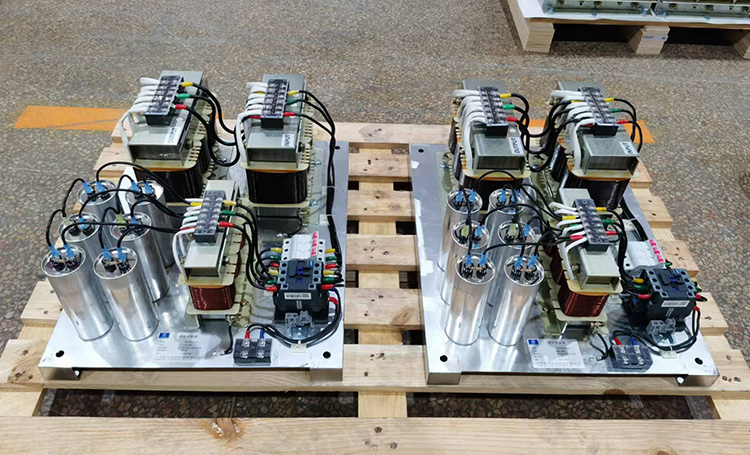
Multi-angle view of industrial detuned reactors and PFC capacitor assembly racks for harmonic mitigation.
Figure 6: Internal structure of detuned reactor and PFC capacitor assembly.

Detuned Reactor: Connected directly in series with the individual PFC capacitor, detuned reactors are applied inside the power factor correction panel to protect your capacitors and anti-resonance. 
Open-panel passive harmonic filter module designed for individual VFD AC input connections.
Figure 7: Modular passive harmonic filter (PHF) for VFD input harmonic mitigation.

Passive Harmonic Filter (PHF): Placed directly at the AC input terminals of individual VFDs, the passive harmonic filter can absorb the harmonic currents at the source. 
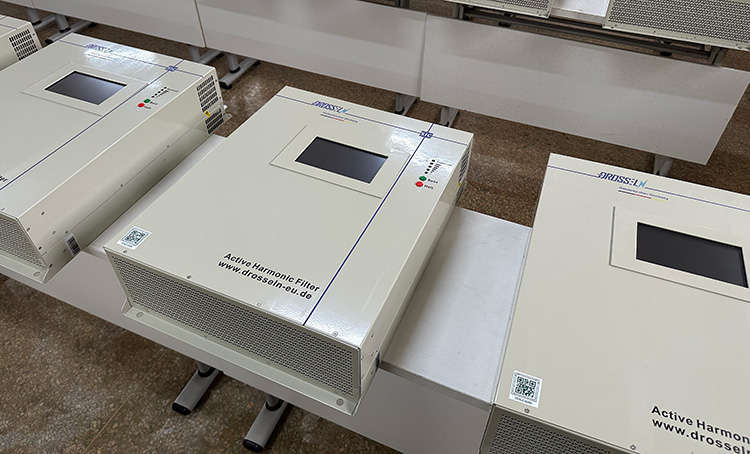
Active harmonic filter (AHF) power modules designed for real-time industrial harmonic compensation and grid monitoring.
Figure 8: Active harmonic filter (AHF) modular units ready for installation.

Active Harmonic Filter (AHF): Connected in parallel at the main busbar, the AHF can monitor and dynamically trap all facility harmonics in real time. 
6. Protection vs. Mitigation: Capacitor Safeguarding vs. IEEE 519 Compliance

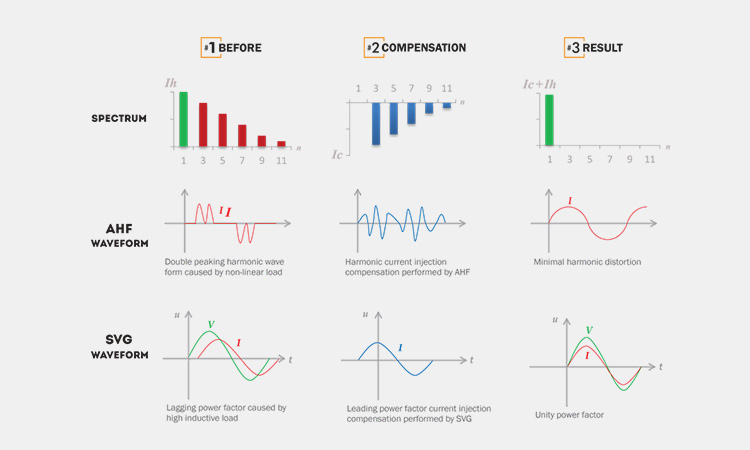
Harmonic mitigation and power quality spectrum analysis showing before and after waveform improvement.
Figure 9: Harmonic spectrum and waveform transformation before and after compensation.

Detuned Reactors (Capacitor Protection)

As the “bulletproof vest” for capacitors, the detuned reactors are only responsible for keeping your PFC capacitor bank from exploding due to resonance. Only handling a little bit of harmonics, they will not clean up your grid. So your overall THDi will still stay around 20% to 30%. 

So if you want to upgrade the capacitor bank, you can choose a detuned reactor. 

Harmonic Filters (Harmonic Mitigation)

Acting as a “powerful, all-around air purifier” for your power grid, the harmonic filter can precisely control your THDi, even when it exceeds 60%. By forcibly suppressing the harmonics below 3%~5%, it can ensure your facility passes strict utility regulations (IEEE 519). 

If you need to clean up your dirty power and make it compliant with strict standards, then a harmonic filter is the right choice. 
7. Tuned Reactor vs. Detuned Reactor: Understanding Resonance Frequency Tuning

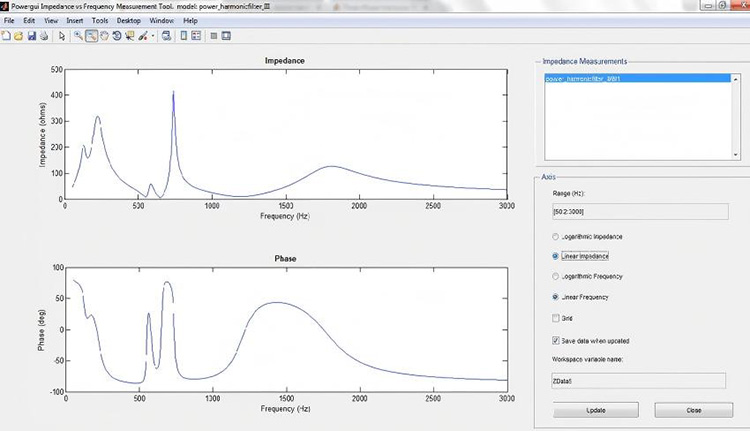
Impedance and phase versus frequency response curve showing harmonic resonance tuning for reactors.
Figure 10: Impedance-frequency response curve for tuned and detuned reactors.

Both of them are reactors, but different in tuning frequency. They are both three-phase iron-core inductors and connected in series with a capacitor to form an LC circuit. However, 

Tuned Reactor (Filter Reactor)

Engineered to target specific harmonic frequencies (e.g., tuned precisely to $250\text{ Hz}$ for 5th harmonic trapping), it is a “harmonic sink” to help you clean up the power. 

Detuned Reactor 

Cleaning up your power system, the detuned reactors can set your harmonic frequency below the lowest harmful levels. They are measured by: 

  • $p = 7\%$ ($f_r = 189\text{ Hz}$ at 50 Hz): The most standard type for grids with moderate 5th harmonic presence ($\text{THDv} < 8\%$).  
  • $p = 5.67\%$ ($f_r = 210\text{ Hz}$ at 50 Hz): Higher tuning for lighter harmonic environments.  
  • $p = 14\%$ ($f_r = 135\text{ Hz}$ at 50 Hz): For heavy industrial grids with 3rd and 5th harmonics. 

8. Performance Comparison: THDi Reduction and Power Factor Improvement

Detuned Reactor PFC Bank

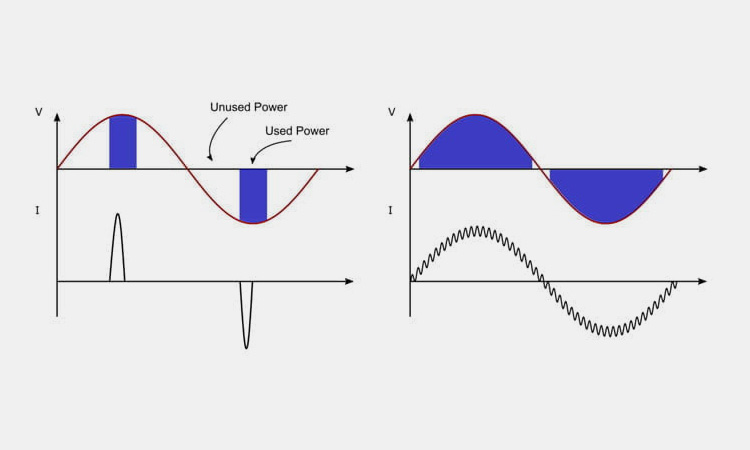
Conceptual waveform showing used power versus unused power to explain power factor correction (PFC) benefits.
Figure 12: PFC benefits: Visualizing power factor improvement and efficient power usage.

Good at power factor correction ($\cos\phi \rightarrow 0.95 – 0.98$), the detuned reactors can keep your power bills low and protect your capacitors from overheating and blowing up. However, they can not clean up your grid harmonics. Your $\text{THDi}$ will still stay around 20%–30%.

Passive/Active Harmonic Filter
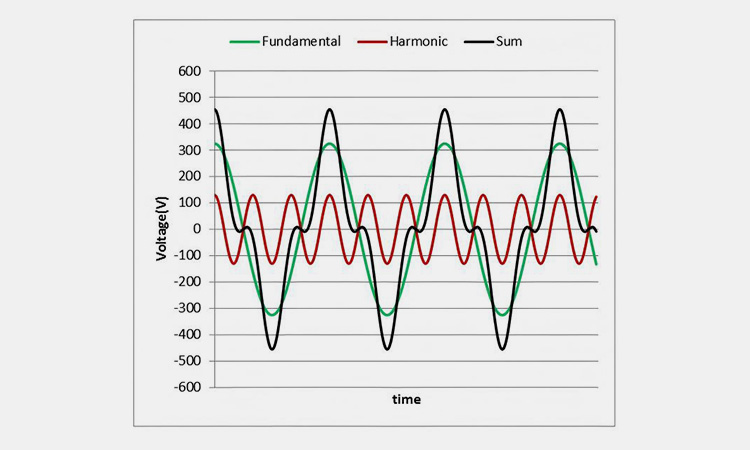
Waveform analysis showing fundamental frequency, harmonic distortion, and sum of electrical grid power quality.
Figure 11: The impact of harmonic distortion on grid power quality.

Excellent at THDi mitigation ($\text{THDi} < 5\%$), the passive and active harmonic filters can sweep away your electrical pollution. They can ensure you are fully compliant with strict utility standards and also help you out with power factor correction.
9. Summary: Detuned Reactor vs. Harmonic Filter

Let’s explore the key differences between detuned reactors and harmonic filters. 


Detuned Reactor (Anti-Resonance)

Passive Harmonic Filter (PHF)

Active Harmonic Filter (AHF)

Primary Function

Protect PFC capacitors; prevent grid resonance.

Trapping drive-generated harmonics.

Dynamic multi-order harmonic cancellation.

Circuit Topology

Series with PFC capacitors.

Series at VFD AC input.

Parallel (Shunt) to main busbar.

THDi Target

Moderate ($\sim20\% – 35\%$).

Excellent ($< 5\% – 8\%$).

Superior ($< 3\% – 5\%$).

IEEE 519 Compliance

No (requires additional filtering).

Yes (at rated drive loads).

Yes (dynamically across all loads).

Resonance Risk

Eliminates resonance.

Engineered to prevent resonance.

Zero resonance risk.

Thermal/Current Linearity

$135\% – 200\%+ I_N$.

High linearity.

N/A (IGBT-based current generator).

Thermal Protection

Integrated NC microswitch ($120^\circ\text{C}-180^\circ\text{C}$).

Thermal switches on coils.

Active heatsink monitoring & rollback.

10. How Does a Detuned Reactor Prevent Capacitor Bank Resonance and Overheating?

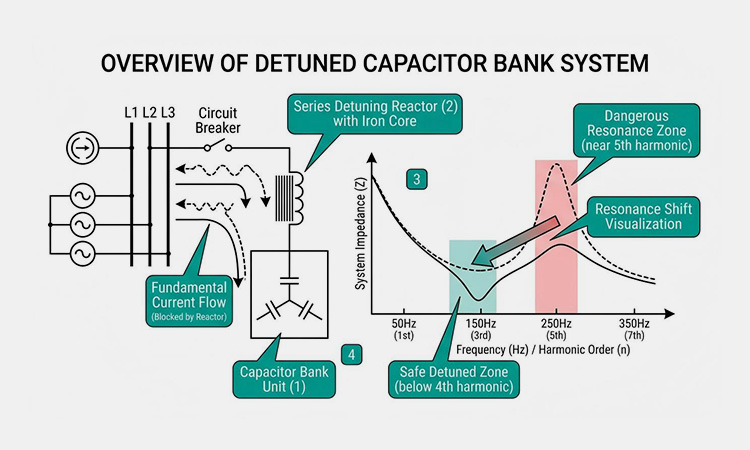
System diagram and impedance frequency curve illustrating how a detuned reactor shifts resonance away from the 5th harmonic dangerous zone.
Figure 12: Overview of detuned capacitor bank system and resonance frequency avoidance.

When you connect a detuned reactor ($L$) and a capacitor ($C$) together, they create a specific tuning frequency:

$$f_r = \frac{1}{2\pi \sqrt{L \cdot C}}$$

In industrial grids, the biggest problem is the 5th harmonic (250 Hz). By using a $7\%$ setting, your frequency will be locked at 189 Hz (for 50 Hz systems). To keep your frequency safely at 189 Hz below 250 Hz, your power grid cannot resonate. 
11. When Is a Power Factor Correction Harmonic Filter Needed?

If your facility is suffering from both poor power factor and high background harmonic distortion, then a harmonic filter is needed. 

Instead of choosing detuned PFC banks, active harmonic filters with detuned PFC banks are the best choice. 

While detuned PFC banks control the bulk reactive load at low cost, active harmonic filters can help clean out harmonics. 

12. Can a Detuned Reactor Replacement Satisfy Strict Utility Limits Alone?

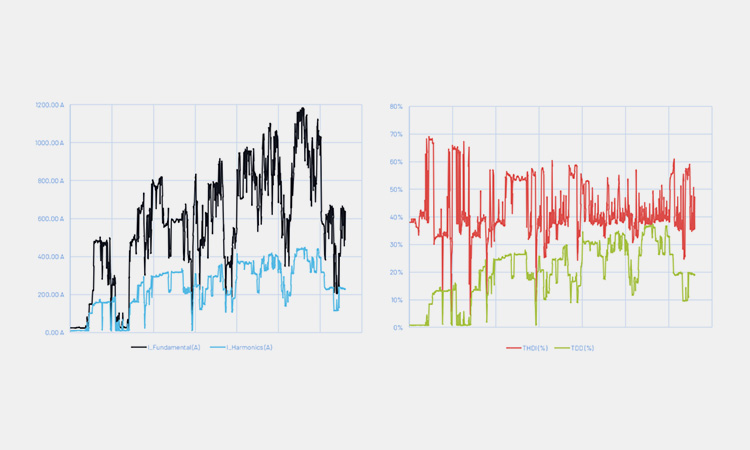
Power quality monitoring chart showing THDi percentage and harmonic current data for IEEE 519 compliance evaluation.
Figure 13: Field measurement chart showing high THDi levels exceeding standard limits.

No. Through detuned reactor PFC can eliminate resonance and protect capacitors, they can not absorb enough harmonic current to help meet strict utility limits like IEEE 519-2022. 

So if your local utility requires $\text{THDi} < 5\%$, not only for anti-resonance or capacitor protection, but also for dedicated passive or active harmonic filters are your best choice. 

To install a harmonic filter alongside the detuned PFC bank, your THDi can be greatly controlled below 5%. 
13. When Should You Choose a Detuned Reactor (Anti-Resonance PFC System)?

You can choose a detuned reactor assembly instead of harmonic filters if:

  • Want to improve power factor and avoid utility low-PF penalties. 
  • Your facility operates VFDs, soft starters, or electronic drives alongside PFC capacitors. 
  • Protect capacitors from bulging, overheating, or repeatedly blowing fuses. 
  • Reduce transformer and cable heating caused by reactive current.

14. When Is a Complete Harmonic Filter System Mandatory?

If you require the following, then a passive or active harmonic filter is needed:

  • Your facility needs to comply with IEEE 519-2022 or EN 50160.
  • If your sensitive equipment, like medical imaging devices, data centers, or precision CNC machines suffering from unexpected trips and faults due to voltage waveform distortion. 
  • When you are installing large 6-pulse VFDs or DC drives in municipal water treatment plants, chemical processing facilities, or oil and gas extraction sites. 

15. Premium Detuned Reactors & Harmonic Filtering Equipment

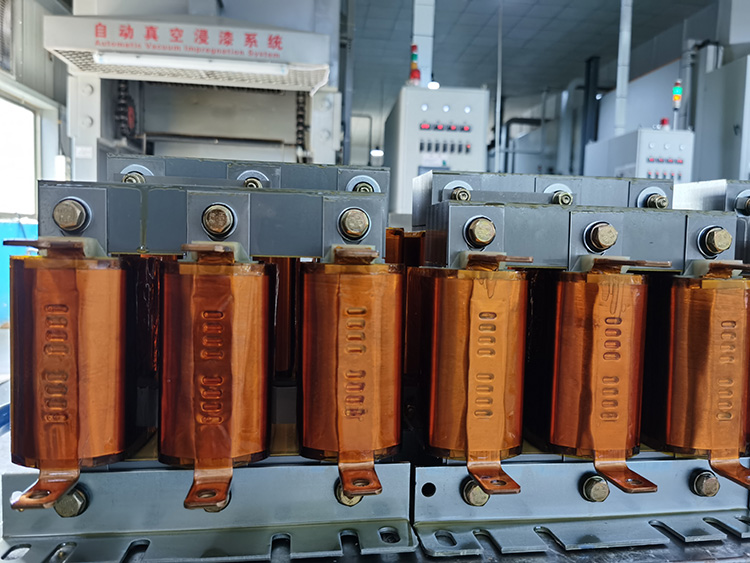
Industrial high-linearity detuned reactor undergoing VPI (Vacuum Pressure Impregnation) process in a manufacturing facility for enhanced reliability and harmonic control.
Figure 14: Advanced VPI manufacturing process for high-linearity, low-loss detuned reactors.

Whether you are looking for premium detuned reactors or harmonic filter solutions, all our reactors and filters are built for harsh industries with reliability. 

High-Linearity Detuned Reactors

Built with $150\% – 200\%$ linearity, our reactor core will never saturate even during heavy harmonic surges. Our VPI technology ensures you quiet, low-loss operation.

Built-In Thermal Safety

Every one of our reactors is embedded with thermal switches ($120^\circ\text{C} – 180^\circ\text{C}$). They can help you with real-time monitoring for overheating. 

Guaranteed Harmonic Control

Our passive filters and dynamic AHF solutions are specifically designed for your power system with guaranteed $\text{THDi} < 5\%$ performance.

Conclusion:

Before choosing a detuned reactor or harmonic filters, you need to identify your system problems first. Are you trying to protect your capacitors while fixing power factor, or are you targeting harmonic distortion to satisfy electrical grid standards?

For Power Factor Correction without resonance risk, you can explore our high-linearity detuned reactors. 

For IEEE 519 harmonic compliance, you can explore our harmonic filter solutions. 

Contact our engineering team today to schedule an on-site power quality audit and custom sizing evaluation!

FAQs About Detuned Reactor vs Harmonic Filter

Can we use a detuned reactor and an active harmonic filter at the same time?

Yes, absolutely.

As an ultimate power quality solution, an active harmonic filter with a detuned PFC bank can both lower your electricity bills and protect your capacitors. At the same time, they can clean out the overall harmonics to guarantee you strict compliance.

Without a detuned reactor, your capacitors may form a parallel resonant circuit with your system transformer.

So there will be severe harmonic amplification. In the end, your factory may face unexpected equipment downtime, blown fuses, and even capacitor explosions.

VFDs are non-linear loads. They may increase your overall background harmonic distortion. The detuned reactors will continue to protect your capacitors. But the overall harmonic pollution might exceed the limits. 

In this case, no need to replace the detuned PFC bank; you can simply install a parallel active harmonic filter at the main busbar. 

In the end, you will get complete compliance.

Yes. 

By using fixed LC or LCL circuits tuned precisely to specific frequencies (like $250\text{ Hz}$ for the 5th harmonic), the passive harmonic filters must be custom-engineered based on your specific load profile.

Yes, the harmonic filter can improve your grid in two ways.

Ensuring a high and stable voltage, it can greatly reduce utility penalty fees. By reducing thermal losses in your transformers and cables, the harmonic filter can save energy and extend your equipment’s lifespan.

Keep Learning